How Much & How Often Should You Feed a Baby? By Age & Feeding Type (With Calculator)
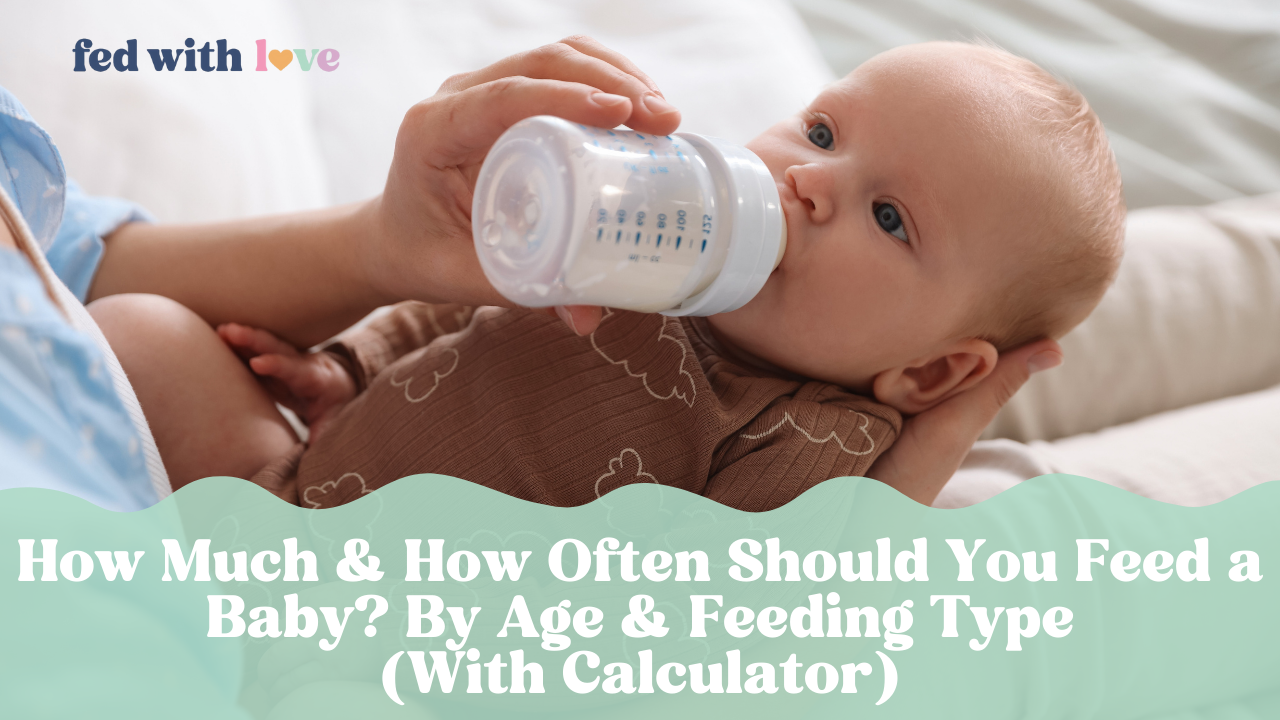
Knowing how much to feed a baby and how often to feed a baby is one of the most common questions parents ask, especially during the newborn months.
Feeding advice online can feel overwhelming and contradictory, leaving many parents wondering whether their baby is eating too much, not enough, or too often.
The truth is that there is no single “right” amount that works for every baby. Feeding guidelines are meant to offer general ranges, not rigid rules.
Just like kids and adults, all babies are different. Their feeding needs vary based on age, weight, feeding method, growth patterns, and development.
This guide breaks down how much to feed a baby by age, how often babies typically eat, the differences between feeding breastfed and formula-fed babies, and how to use feeding estimates while listening to your baby’s hunger and fullness cues.

Before You Count Ounces: Feeding Guidelines Are Estimates, Not Rules
Feeding recommendations are broad because babies are not robots. Some babies eat larger volumes, some eat smaller amounts more frequently, and both patterns can be completely normal.
Feeding should never be about forcing a baby to finish a bottle or hit a specific number of ounces. Instead, feeding should be responsive, offering milk when your baby shows hunger cues and stopping when they are full.
Understanding your baby’s hunger cues is very important. Look for early hunger cues like rooting, licking or smacking lips, bringing hands to the mouth, or making sucking motions. Remember, agitation and crying are late hunger cues.
Baby Feeding Calculator
How much should you feed your baby?
By using this tool, you understand it is for educational purposes only. Please speak with your pediatric provider about how much to offer your baby. All amounts are estimates. Some babies will eat more and others less.
Baby Feeding Calculator: How Much Should My Baby Eat by Weight?
By using this calculator you understand that it is for educational purposes only. Erin Moore, CPNP, IBCLC is not your baby’s medical provider. Please speak with your pediatric provider before adjusting your baby’s feeds.
This estimate provides a helpful starting point, but it should never outweigh your baby’s hunger cues and guidance from your pediatric provider.
Feeding calculators are designed to give ranges, not targets. It is normal for intake to vary from day to day, especially during growth spurts or developmental changes.
How Much to Feed a Baby by Age (Newborn to 12 Months)
As babies grow, both feeding volume and frequency change. Stomach capacity increases over time, allowing babies to take larger feeds less frequently.
How Much to Feed a Newborn (0 - 4 Weeks)
In the early newborn period, babies have very small stomachs and need to eat often. Formula-fed newborns typically start with about 1/2–2 ounces per feeding every 2-3 hours, gradually increasing as they grow.
Breastfed newborns usually nurse on demand, no longer than every 2-3 hours. On days 1-3 of life, breast fed babies often eat 10-12 times and get very small amounts of colostrum. Frequent milk removal will help tell the body to make more milk and help milk transition from colostrum to more mature milk.
Because breastmilk digests more quickly than formula, breastfed babies often feed more frequently, especially in the first weeks of life.
Newborns who are sleepy or not yet back to birth weight may need to be woken to feed, based on guidance from a pediatric provider.
Newborns should be weighed often to ensure their weight gain is between 0.8-1 ounce per day.
How Much to Feed a 1 - 3 Month Old
By one to three months of age, many babies are able to take slightly larger volumes per feeding. Formula-fed babies often take between 2-4 ounces per feed by one month and may increase to 3-5 ounces by two to three months, typically feeding every 3-4 hours.
Breastfed babies may continue feeding every 2-3 hours, with intake varying throughout the day. Growth spurts are common during this stage and can temporarily increase feeding frequency.
Cluster feeding is common between one to three months. It happens with both breast fed and bottle fed babies, and typically occurs in the late afternoon or evening.
It is common for babies to have digestive concerns around this time as the digestive system is maturing.
How Much to Feed a 4 - 6 Month Old
Between four and six months, many babies settle into more predictable feeding patterns. Formula-fed babies often take 4-6 ounces per feeding a few times per day. Some families begin introducing solid foods during this window, but breastmilk or formula should remain the primary source of nutrition.
Breastfed babies often continue eating every 2.5 to 3 hours and may take between 3-5 ounces per feeding.
While formula fed babies often start taking larger amounts less often, babies drinking breast milk often stay with smaller amounts more frequently with (hopefully) a longer period of sleep during the night.
Milk intake may shift slightly as solids are introduced, but significant drops in milk intake are not expected at this stage.
How Much to Feed a 6 - 12 Month Old
As babies continue to grow and eat more solid foods, milk intake may gradually decrease.
Many formula fed babies take 5-8 ounces per feeding and continue bottle-feeding three to five times per day. Total daily intake for formula-fed babies often falls between 24-30 ounces, though some babies may take more or less.
Breastfed babies often continue eating between 4-6 ounces per feed and eat more frequently than formula fed babies. Breastmilk gets more dense in calories and often decreases as babies near a year
Even with solids, breastmilk or formula will remain the main source of calories and nutrients through the first year of life.
How Often Should You Feed a Baby?
How often you feed your baby changes as babies grow, but feeding on demand remains important throughout the first year.
Newborns typically eat every 2–3 hours, but may be hungrier before. Since babies don’t follow a clock, they may show hunger cues at 1 hour, 1.5 hours or right before 2 hours.
By one to three months, many formula fed babies begin spacing feeds to every 3-4 hours. Between four and six months, formula feeds may occur every 3–5 hours, with longer stretches of sleep overnight becoming more common.
It is not uncommon for breastfed babies to continue eating smaller amounts every 2-3 hours throughout the first year.
As solids are introduced between six and twelve months, babies often continue milk feeds four to six or seven times per day.
Feeding schedules should remain flexible…babies should eat when hungry instead of following a clock or a strict schedule.

How Much to Feed a Breastfed Baby
Breastfed babies often eat smaller amounts more frequently than formula-fed babies because breastmilk is digested more quickly. It is common for breastfed babies to nurse every 2-3 hours throughout infancy, including well into the first year.
Because it is difficult to measure the exact amount of breastmilk consumed while nursing, parents should rely on diaper output and weight gain rather than ounce counts.
Frequent feeding is normal and does not mean milk supply is inadequate.
If you are concerned about how much your breastfed baby is eating, schedule an appointment with a lactation professional for a weighted feed. A weighted feed or lactation visit can provide reassurance along the feeding journey.
How Much to Feed a Formula-Fed Baby
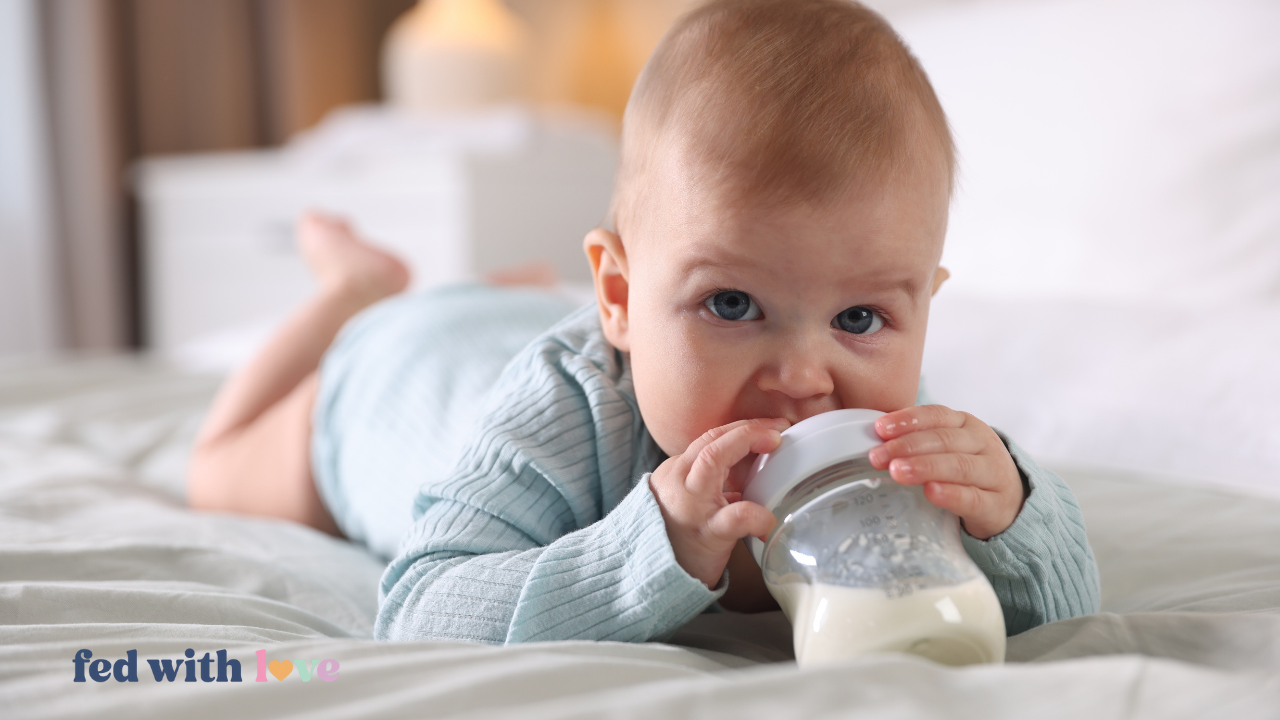
Formula-fed babies tend to take larger volumes per feeding and may go longer between feeds as they grow. In the first month, babies often take 2-3 or more ounces per feeding every 2-3 hours. By two to three months, many babies take 3-6 ounces per feed, five or six times per day. The amounts are different baby to baby.
By six to twelve months, feeds often increase to 5-8 ounces per feeding, three to six times per day. A common guideline used by pediatric providers is approximately 2.5 ounces of formula per pound of body weight per day, though individual needs vary .
Some formula-fed babies may get more than 32 ounces per day and still be perfectly healthy.
Please speak with your pediatric provider if you have any concerns about how much your baby is eating.
How Much Formula Should a Baby Drink in 24 Hours?
One of the most common questions parents ask is: how much formula should a baby drink in 24 hours?
While feeding amounts vary by baby, a common guideline used by pediatric providers is:
Approximately 2.5 - 3 ounces of formula per pound of body weight per day, up to 10 pounds.
For example:
-
An 8-pound baby may take around 20-24 ounces per day
-
A 12-pound baby may take around 24-32 ounces per day
-
A 16-pound baby may take around 24-32 ounces per day
This is a range, not a target. Some babies need slightly more, and some need slightly less.
When parents search “how many ounces should a baby drink per day,” they are often worried about underfeeding or overfeeding. What matters most is:
-
Steady weight gain
-
At least 6 wet diapers per day after the newborn stage
-
A baby who appears content between feeds
For formula-fed babies between 2–6 months or a baby who is 10 pounds or over, total daily intake recommendations often falls between 24–32 ounces per day, though some babies may exceed 32 ounces and still grow appropriately.
Breastfed babies are different. Because breastmilk intake cannot be measured directly at the breast, daily ounce totals are not typically used. Instead, we look at weight gain, diaper output, and feeding behavior.
Remember: daily totals matter more than one individual feeding. Babies may take smaller feeds in the morning and larger feeds in the evening. Intake naturally varies.
How Much Should a Combo-Fed Baby Eat?
Parents who are combination feeding often ask me how much to feed a combo fed baby or how much formula to supplement with breastmilk.
Combination feeding can feel confusing because you are balancing two milk sources.
Here are general principles:
-
Offer the breast milk first whenever possible to support milk supply.
-
Supplement with formula based on hunger cues, not a fixed number.
-
Avoid automatically offering a full bottle after every nursing session unless medically indicated.
If your baby nurses and still shows hunger cues (rooting, sucking hands, staying alert), offering 1–3 ounces of formula may be appropriate depending on age and weight.
Oversupplementing can sometimes reduce milk supply, so amounts may need to be adjusted gradually.
If you are unsure how much your combo-fed baby should eat, a weighted feed with a lactation professional can help estimate breastmilk transfer and guide formula supplementation.
Combo-fed babies often follow similar total daily intake ranges (24–32 ounces combined breastmilk + formula after the newborn period), but individual needs vary.
How Feeding Changes When Babies Start Solids
As babies begin eating solid foods, milk intake may slowly decrease, but breastmilk or formula should remain the primary source of nutrition until age one.
Breastmilk becomes more calorically dense over time, while formula-fed babies often need higher volumes to meet increasing calorie needs.
I recommend starting solids slowly, usually once per day, and then increasing as your baby gets closer to one. This helps ensure that breast milk or formula will be the main source of nutrients and helps maintain milk supply.
How Much Do Babies Eat During a Growth Spurt?
It is very common for parents to ask how much a baby should eat during a growth spurt or Google things like baby growth spurt feeding increase.
Growth spurts typically occur around:
-
2–3 weeks
-
6 weeks
-
3 months
-
6 months
During a growth spurt, babies may:
-
Eat more frequently
-
Take larger bottles
-
Cluster feed in the evening
-
Seem hungrier than usual
This phase usually lasts 2-3 days, sometimes up to a week.
For breastfed babies, frequent feeding during a growth spurt helps signal the body to increase milk production. For formula-fed babies, you may notice they temporarily increase total daily intake.
This does not mean something is wrong. It does not automatically mean you need to switch formulas. And it does not mean your milk supply is low.
Feeding on demand during growth spurts supports healthy weight gain and development.
How to Tell If Your Baby Is Eating Enough
Babies who are eating enough typically have at least six wet diapers per day after the newborn period, have steady weight gain, and appear content between feeds.
Hunger and fullness cues, such as opening the mouth eagerly when hungry or turning away when full, are important indicators that feeding is going well.
If concerns arise about intake, growth, or feeding behavior, contact your baby’s pediatric provider.
When to Worry About How Much Your Baby Is Eating
Parents frequently search: baby not eating enough, baby eating too much, or when to worry about baby feeding.
While variations in intake are normal, speak with your pediatric provider if you notice:
-
Fewer than 6 wet diapers per day after the newborn stage
-
Poor or slowing weight gain
-
Persistent lethargy
-
Vomiting after most feeds (not just normal spit-up)
-
Refusal of multiple consecutive feeds
-
Excessive discomfort during or after feeds
Concerns about intake are common, especially in the first few months. In many cases, reassurance, feeding adjustments, or nipple flow evaluation solves the issue.
Remember: feeding your baby is not about hitting a perfect ounce number. It is about supporting growth, development, and a positive feeding relationship.
Baby Feeding FAQs: How Much and How Often to Feed a Baby
How much milk should a newborn drink per feeding?
Newborns have very small stomachs. It is typical for a breast fed newborn to get a few milliliters of breastmilk on days 1-2 of life. Breastmilk often transitions from colostrum (early milk) to more mature milk by days 3-5.
Formula fed babies often eat more immediately after birth. I recommend following hunger and fullness cues. I like to remind parents that even though ready-to-feed bottles are 2 ounces, newborn babies often need less to meet their demands.
How many ounces should a baby drink by age?
The amount a baby eats is typically based on weight and not age. You can refer to the feeding calculator above for rough estimates and ranges.
Can you overfeed a baby?
Yes. Overfeeding can happen, especially with bottle feeding, when caregivers encourage finishing a bottle instead of following hunger and fullness cues.
Signs may include frequent spit-up, discomfort after feeds, gas, or rapid weight gain. If a baby is gaining too much weight too fast, I like to evaluate what bottle nipple and flow rate they are using and how they are feeding their baby. Paced feeding and breaks are important.
How do I know if my baby is still hungry?
Signs of hunger include rooting, sucking on hands, lip smacking, fussing after feeds, or staying alert while feeding. A full baby may slow sucking, turn away, relax their hands, or fall asleep. Cues matter more than ounces.
Do breastfed babies eat less than formula-fed babies?
Breastfed babies often take smaller, more frequent feeds because breast milk digests faster than formula. Intake looks different, but it is more important to look at growth, wet diapers, and development.
How often should I feed my baby at night?
Newborns usually need to eat every 2–3 hours overnight. As babies grow, some naturally sleep longer stretches while others continue night feeds. Feeding needs vary by age, weight, and development.
Should feeding amounts change during growth spurts?
Yes. Babies often eat more frequently or take larger feeds for a few days during growth spurts. This is normal and temporary, and feeding on demand supports healthy growth. It happens to both breastfed and formula fed babies.
Feeding your baby is not about hitting a number.
It is about responding to hunger cues and feeding
Whether your baby is breastfed, formula-fed, or combo-fed, feeding with flexibility and trust supports both nutrition and the parent–baby relationship. Numbers are tools, not rules, and your baby’s cues matter most.
free guide
The FREE Printable 150 First Foods Guide
We hate SPAM. We will never sell your information, for any reason.